
Commercial Battery Storage in Australia vs Residential Batteries: What’s the Difference?
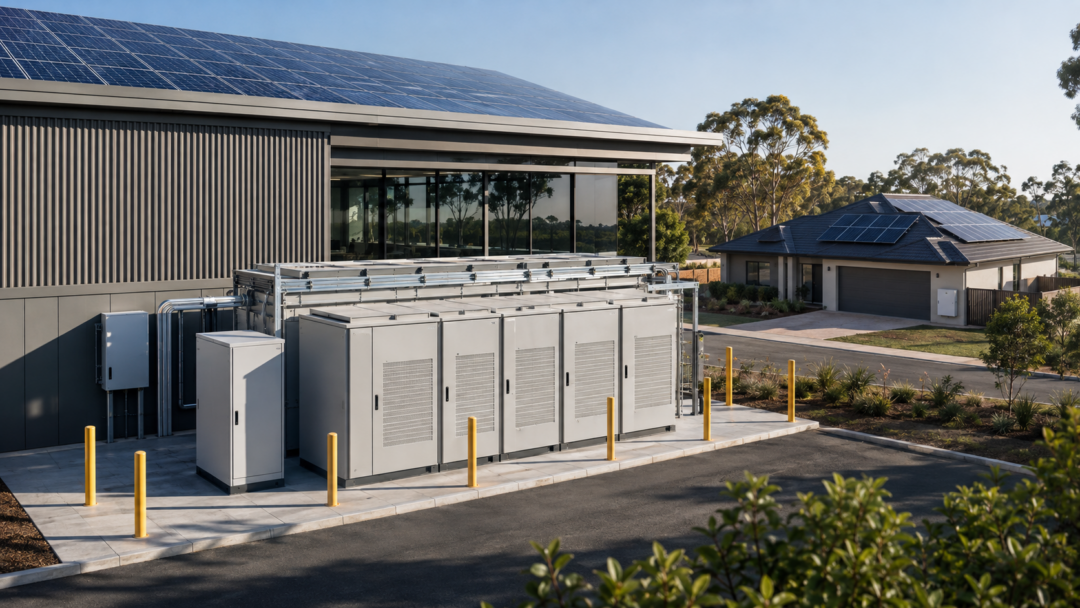
A battery that powers a home and a battery that supports a warehouse may use similar underlying chemistry, but the comparison largely ends there. Commercial battery systems are designed around business loads, tariff structures, operating hours, risk controls and measurable commercial outcomes. They need to do more than store extra solar energy.
For organisations researching commercial battery storage in Australia, the key question is not simply, ‘How large a battery can we install?’ It is, ‘What operational or financial problem should the system solve, and how must it perform to solve it reliably?’
Commercial vs residential battery storage at a glance
|
Area |
Residential battery |
Commercial battery |
|---|---|---|
|
Primary purpose |
Household solar self-consumption and optional backup |
Cost control, peak management, resilience, electrification and operational goals |
|
Scale |
Sized for one household and selected appliances |
Sized for site loads, from modular cabinets to much larger systems |
|
Energy pattern |
Relatively predictable daily routine |
Variable loads shaped by production, HVAC, refrigeration, tenants, fleets or shifts |
|
Electrical design |
Usually integrated with a domestic switchboard |
May require three-phase engineering, switchboard works, protection studies and network approval |
|
Controls |
Consumer app and basic schedules |
Energy management software, automated dispatch, alarms, reporting and remote support |
|
Business case |
Bill savings, solar use and household resilience |
Multiple value streams tested against capital cost, degradation, finance and operational risk |
What is residential battery storage?
A residential battery is typically designed to store energy for one household. It may charge from rooftop solar during the day and discharge in the evening when the home’s electricity use increases. Depending on the system design, it may also supply selected circuits during an outage.
Residential systems usually operate within a relatively simple environment: one meter, a limited number of major loads and a familiar daily pattern. The homeowner may use an app to view charge levels, solar production and household consumption. Financial value is commonly assessed through household bill savings, increased use of rooftop solar and the personal value placed on backup power.
What is commercial battery storage?
Commercial battery storage is designed around the electrical and operational needs of a business site. That site might be an office, shopping centre, factory, warehouse, farm, hospital, school, data facility or multi-site property portfolio. Each has a different load profile, different critical equipment and different exposure to energy costs or downtime.
A commercial system may charge from solar, from the grid during selected tariff periods, or through a controlled combination of both. It may then discharge to reduce a demand peak, shift energy to a more valuable time, support critical loads, manage EV charging or help meet a broader energy strategy. The controls, not only the battery hardware, determine whether those goals are achieved.
1. Capacity and power must match the business load
Battery discussions often focus on kilowatt-hours, or kWh. This is the amount of energy the battery can store. Commercial projects must give equal attention to kilowatts, or kW, which describe how quickly the system can deliver power.
A battery can have enough stored energy to run a load for several hours but still lack the power output to support a sudden production peak. The reverse is also possible: a system may deliver high power but exhaust its usable energy quickly. Effective sizing therefore considers both the height of the load and how long it needs to be supplied.
Commercial systems also need to account for usable capacity, depth of discharge, round-trip losses, expected cycling, temperature, degradation and warranty conditions. Comparing nameplate capacity alone can produce a misleading result.
2. Commercial usage patterns are more complex
Many households follow a broad pattern of lower daytime use and higher morning or evening use. Businesses can be much less predictable. A site’s load may change with production schedules, refrigeration cycles, air conditioning, tenant activity, weekend trade, seasonal demand, fleet charging or a single large item of equipment starting.
This is why a commercial battery should be assessed against interval data, not only annual consumption or the total shown on a monthly bill. Australian Government guidance notes that understanding the characteristics of a business’s demand profile is essential to managing energy costs. The same data shows when a battery could charge, when it would need to discharge and whether it can be ready for the next event.
The control strategy may also need to prioritise competing goals. For example, using most of the battery to reduce afternoon demand could leave less stored energy for backup later that evening. The operating logic should reflect which outcome matters most to the business.
3. Installation is an engineering project, not an appliance purchase
A home battery can often be installed near a domestic switchboard, subject to the product instructions, site conditions and applicable requirements. A commercial battery may require a dedicated outdoor area, multiple cabinets, a containerised enclosure, new switchboards, transformers, protection equipment, communications infrastructure and civil works.
The project team may need to assess three-phase loads, fault levels, protection coordination, cable routes, access for maintenance, vehicle impact risks, drainage, flood exposure, ventilation or thermal management, noise, emergency access and future expansion. The electricity network may also require an application, technical studies, export controls or changes to the site connection.
These requirements affect cost, program and feasibility. A battery that looks attractive on a product data sheet may not suit the available space, switchboard capacity or network conditions at the site.
4. Monitoring and controls become business-critical
Residential battery monitoring is generally designed for a homeowner who wants a clear view of solar production, household consumption and state of charge. Commercial monitoring needs to support operational decisions and ongoing asset management.
A commercial energy management system may use interval data, tariffs, solar forecasts, site demand and battery limits to decide when to charge or discharge. It may also provide alarms, remote diagnostics, user permissions, performance reports and integration with building management systems, EV chargers or other site controls.
This matters because savings are not created by stored energy alone. They depend on the battery being available and dispatched at the right time. Monitoring should also make it possible to confirm whether the system is delivering the outcome used in the original business case.
5. Safety and compliance scale with the project
Both residential and commercial batteries must be selected, designed and installed safely. Commercial sites introduce additional complexity because they may store more energy, operate around employees or the public, sit near vehicles or production areas, and interact with larger electrical systems.
The design should address applicable Australian Standards, product requirements, electrical regulations, network rules, building and fire requirements, manufacturer instructions and site-specific risks. AS/NZS 5139 is a key Australian installation standard for battery energy storage systems used with power conversion equipment, while product safety requirements and approved-product settings continue to evolve.
Emergency planning should be developed with the site, not added after installation. That can include isolation procedures, signage, access controls, emergency response information, staff responsibilities and arrangements for inspection, monitoring and maintenance.
6. ROI is based on business outcomes, not battery size
A residential buyer may compare the purchase price with expected household bill savings and the personal value of backup power. A commercial investment normally requires a more detailed model because several value streams and costs can interact.
Peak-demand management
Some business tariffs include demand charges based on the highest level of electricity used during a defined period. The Australian Energy Regulator explains that demand charges may be based on maximum use during a specified demand window or above a threshold. A battery may reduce that peak by discharging at the right moment, but the result depends on the tariff, battery power rating, available state of charge and control settings.
Using more onsite solar
If a business exports surplus solar during the day and imports electricity later, storage may shift some of that generation to a time when the site can use it. The value depends on the export rate, import tariff, energy losses and the site’s actual after-solar load. A battery does not create more solar energy. It changes when part of that energy is available. If your business already has solar, see our guide to commercial solar battery storage.
Operational resilience
For sites where outages can interrupt revenue, damage stock or stop critical processes, resilience may form part of the business case. However, backup power is not automatic. The battery, inverter, switchgear and controls must be designed to operate in backup or island mode, and the critical loads must be clearly defined. Runtime will depend on the load, available stored energy and how the system is configured.
Electrification and EV charging
Battery storage may help manage the additional load from electric vehicles, heat pumps or new electrical equipment. It can buffer short peaks or shift part of the demand, but it does not remove the need to assess total energy use, charging behaviour, connection capacity and future growth.
Whole-of-life costs
A credible ROI model includes capital works, connection costs, software, maintenance, insurance implications, financing, efficiency losses, degradation, augmentation or replacement assumptions and the warranty. It should test conservative and less favourable scenarios, not only the strongest forecast.
When commercial battery storage may not be the right next step
A battery can be valuable, but it is not automatically the best investment for every business. If a site already consumes most of its solar generation as it is produced, has little exposure to demand charges, operates on a tariff with limited time-based differences or has few repeatable peaks, the available savings may be modest.
The case may also be weakened by a constrained connection, unsuitable space, a short lease, planned site changes, limited access for maintenance or an unrealistic expectation of outage support. In some cases, energy efficiency, load scheduling, solar expansion, power-factor correction, smart EV charging or tariff changes should be assessed before, or alongside, battery storage.
The purpose of a feasibility assessment is not to justify a battery at any cost. It is to identify whether storage solves a real site problem better than the available alternatives.
What should a business assess before investing?
Energy data: At least 12 months of interval consumption data is usually more useful than annual totals because it shows the timing, size and frequency of demand events.
Tariff and bills: The model should reflect actual usage charges, demand charges, network components, export rates and any contract conditions relevant to the site.
Solar performance: Existing or planned solar generation should be compared with site demand to identify genuine surplus and charging windows.
Operational goals: The business should rank cost reduction, backup, solar utilisation, EV charging, emissions goals and other outcomes rather than assume one system can maximise everything at once.
Site and connection: Space, switchboards, transformers, cable routes, fire and access considerations, network requirements and future development can materially affect feasibility.
Commercial assumptions: Savings, losses, degradation, warranty limits, maintenance, finance and equipment life should be visible and tested in the business case.
Frequently asked questions
Is commercial battery storage just a larger home battery?
No. It may use similar cell chemistry, but a commercial system is engineered around larger and more variable loads, business tariffs, network requirements, site safety, advanced controls and measurable operational outcomes.
Can a commercial battery keep a business running during a blackout?
Only if the system is designed for backup or island operation. A standard grid-connected battery may shut down when the grid fails. The design must identify the critical loads, required runtime, switching method and operating limitations.
Will a battery reduce every business’s electricity costs?
No. Savings depend on the site’s load profile, tariff, solar generation, battery size, control strategy, losses, degradation and capital cost. Some sites have a strong use case, while others may achieve better results from efficiency or load management first.
Can a commercial battery be added to an existing solar system?
Often, but compatibility and feasibility must be assessed. The existing inverter arrangement, switchboard, metering, export controls, connection agreement, available space and desired operating mode all affect the design.
How long does a commercial battery last?
Service life depends on chemistry, temperature, cycling, depth of discharge, operating strategy and maintenance. Compare warranties by years, cycle limits, energy throughput and warranted remaining capacity rather than looking at a single headline number.
What is the first step in assessing commercial battery storage?
Start with the site’s interval energy data, bills, tariff, solar data, critical-load requirements and future operating plans. This allows a feasibility study to size and model the system around a defined business outcome before products are compared.
Choose a system around the outcome your business needs
Commercial battery storage should be treated as energy infrastructure, not a scaled-up household appliance. The right system combines appropriate capacity and power with safe engineering, intelligent controls and a commercial model grounded in the way the site actually operates.
CBS Australia can assess your interval data, tariff, solar generation, critical loads, site constraints and future energy plans to determine whether battery storage is suitable for your business. Speak with our commercial battery specialists about a site-specific feasibility assessment.