
Australia Now Ranks Third in the Global Battery Storage Market
Australia has moved into the top tier of the global battery market. The Clean Energy Council’s Clean Energy Australia 2026 report ranks the country third in the world for utility-scale battery storage by total capacity, behind China and the United States.
That distinction matters. It refers to large batteries connected to the electricity system, rather than every residential or commercial battery installed across the country. Even so, the result shows how quickly storage has moved from a supporting technology to a central part of Australia’s energy system.
For businesses researching battery storage in Australia, the national ranking is more than an industry headline. It signals a maturing market, falling technology costs and a clearer role for storage as companies seek more control over energy use, better returns from solar, stronger operational resilience and capacity for future electrification.
What the third place ranking means
The Clean Energy Council reported that 2025 was a breakthrough year for batteries. A record 4.3 gigawatts of new large-scale battery capacity, representing $4.8 billion in investment, reached financial commitment. Another 2 gigawatts was commissioned during the year, more than three times the capacity added in 2024. Utility-scale battery costs also fell by 20 per cent over the year.
These figures show both market scale and delivery momentum. Financial commitment indicates that developers and investors are backing new projects, while commissioning shows that more batteries are becoming operational. Together, those measures explain why Australia has risen so quickly in the global rankings.
The growth is also broader than the utility market. More than 268,000 home batteries were installed in 2025, according to the same report. Businesses and households are increasingly treating storage as part of their energy planning rather than as an experimental add-on.
Why battery storage is growing so quickly in Australia
More renewable energy needs flexible storage
Renewable energy supplied 42.7 per cent of Australia’s electricity in 2025, while millions of properties already had rooftop solar. Solar and wind can produce large volumes of low-cost electricity, but their output does not always align with demand. Batteries absorb electricity when supply is abundant and release it later, helping match generation with consumption across the day.
AEMO’s 2026 Integrated System Plan describes storage as a core part of the least-cost pathway for the National Electricity Market. Its modelling projects a need for 35 gigawatts of shallow and medium storage by 2050 for intraday firming, with batteries expected to provide most medium-duration storage.
Coal retirements and rising demand increase the need for flexibility
Australia is adding storage while ageing coal generation retires and electricity demand grows. AEMO expects electricity consumption to almost double over the coming decades, driven by population and economic growth, electrification across homes and businesses, industrial change and new loads such as data centres.
Storage cannot replace every function of the existing system on its own. It works alongside renewable generation, transmission, demand management, hydro and other firming resources. Its ability to charge and discharge quickly, however, makes it valuable when supply or demand changes over short periods.
Costs have fallen while the project pipeline has expanded
Lower battery costs have improved the economics of large projects and widened the range of potential commercial uses. AEMO reported that the grid-scale storage connections pipeline grew from 3 gigawatts in September 2022 to 45 gigawatts in 2026. Not every proposed project will be built, but the size of the pipeline shows how strongly developers are responding to the need for flexible capacity.
Large-scale battery storage in Australia
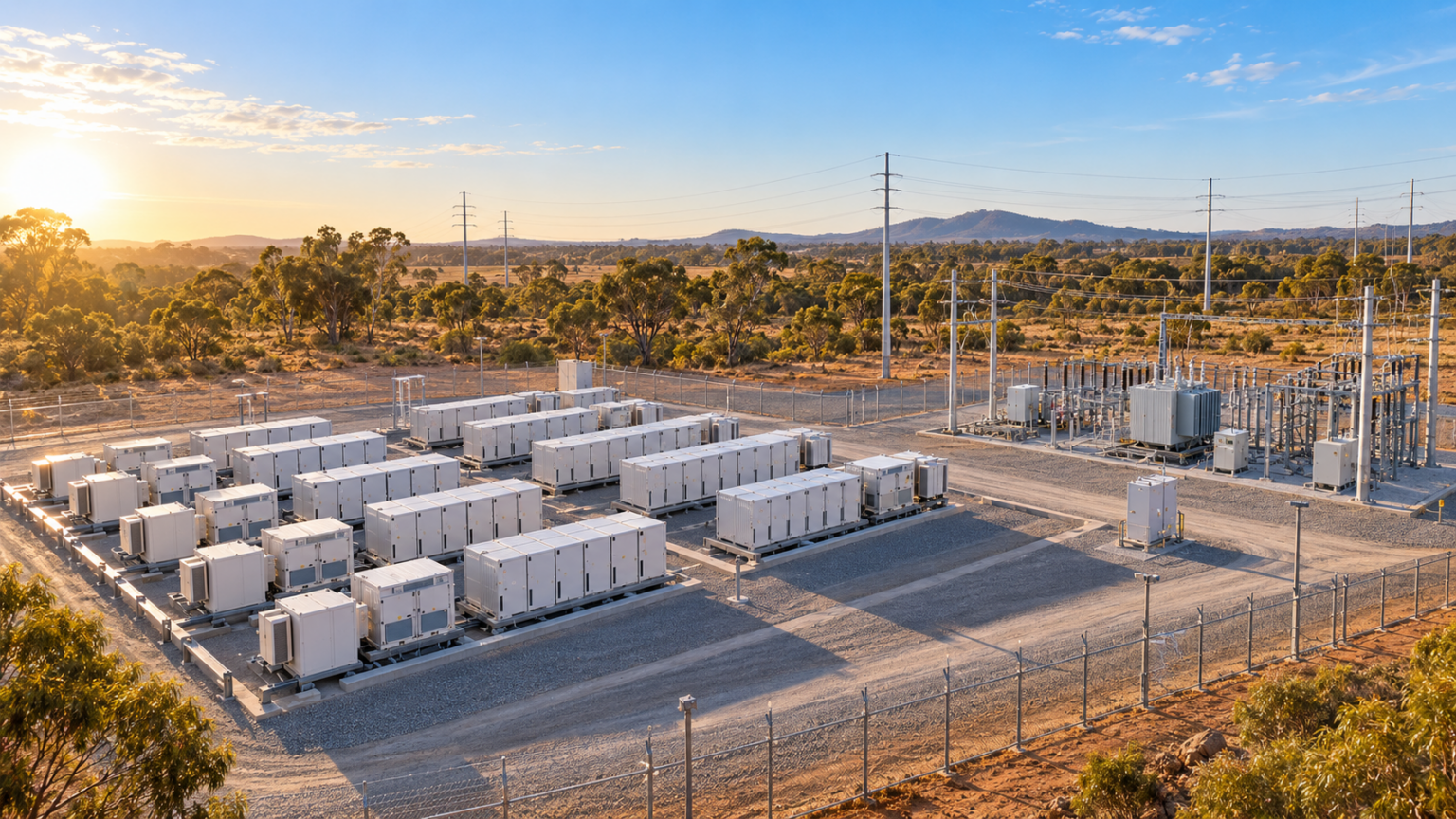
Large-scale battery storage is behind most of Australia’s rise in the global rankings. These grid-connected systems, often hundreds of megawatt-hours each, store energy from solar and wind farms and release it during evening peaks or when supply tightens. The 4.3 GW of new large-scale capacity that reached financial commitment in 2025 shows how fast developers are building, and the grid-scale connections pipeline has grown from 3 GW in 2022 to 45 GW.
The same technology now reaches large commercial and industrial sites. Containerised systems that once belonged only to utilities are being installed at distribution centres, manufacturing plants and mining operations that need multi-megawatt-hour storage. Examples include:
- Sungrow PowerTitan, a 5,000 kWh / 2,500 kW utility-scale system
- AmpAura RCT Power CESS 4000, a 4,073 kWh containerised ESS
- WEnergy Turtle Container ESS, including 3.85 MWh configurations
For businesses, large-scale battery storage brings down technology costs and builds supplier experience, which makes commercial projects easier to finance and deliver.
What the national momentum means for businesses
| Business opportunity | How battery storage may help |
|---|---|
| Energy control | Shift grid purchases, manage demand peaks and automate charging around operating needs and tariffs. |
| Solar utilisation | Store genuine daytime surplus for use when the business would otherwise import electricity. |
| Operational resilience | Support defined critical loads during an outage when the system is designed for backup operation. |
| Future electrification | Help manage additional peaks from EV charging and new electric equipment as site demand grows. |
Actual value depends on the site load profile, tariff, solar generation, connection and system design.
Better control over when energy is purchased
Commercial energy costs depend on more than the total number of kilowatt-hours used. Time-of-use rates and demand charges can make the timing and intensity of electricity use important. A battery may charge when electricity is less expensive or when onsite solar is available, then discharge during a higher-cost period or a short demand peak.
The result depends on the tariff and the control strategy. A battery must have enough power, usable capacity and state of charge to respond at the right time. This is why interval data and actual bills should drive the business case rather than a generic savings estimate.
Stronger returns from onsite solar
Many commercial sites generate solar energy during daylight hours but cannot consume all of it at the time it is produced. A battery can store part of that genuine surplus and make it available later, increasing solar self-consumption and reducing the need to buy electricity from the grid.
The Australian Government notes that batteries can reduce grid purchases, reduce solar curtailment and increase self-sufficiency. The financial value still depends on the difference between the avoided import cost and the value of exporting that energy, after allowing for efficiency losses and battery degradation.
Improved resilience where downtime carries a cost
For a warehouse, manufacturing site, cold-storage facility, healthcare operator or data-dependent business, even a short outage can interrupt production, damage stock or stop essential services. A battery can form part of a resilience plan, but backup is not automatic.
The inverter, switchgear and controls must be configured for backup or island operation. The business must also define which loads are critical, how long they need to run and what happens if an outage occurs when the battery is partly discharged. Resilience should be engineered as a specific operating mode, not assumed from the battery’s nameplate capacity.
Preparation for EV charging and wider electrification
Businesses are adding electric vehicles, chargers, heat pumps, electric process equipment and other new loads. These changes can increase total consumption and create new peaks that exceed the capacity available at a site or increase demand charges.
Battery storage may buffer short peaks, coordinate charging and defer part of a connection upgrade in suitable cases. It does not remove the need to assess the site’s switchboards, network connection, charging schedules and long-term load growth. The battery should be planned as part of the electrification strategy, not added after new loads create a constraint.
Market growth does not guarantee a strong business case
Australia’s market position improves confidence that battery storage will play a lasting role in the energy system. It does not mean every commercial site should install a battery now.
A site that already uses most of its solar as it is generated, has limited tariff variation, experiences few demand peaks or has low outage exposure may receive modest value from storage. Space constraints, switchboard limitations, network requirements, a short lease or planned redevelopment can also weaken the case.
A credible feasibility study should compare battery storage with alternatives such as energy efficiency, load scheduling, solar expansion, power-factor correction, tariff changes or managed EV charging. The preferred option is the one that solves the business problem at an acceptable cost and risk.
What to assess before investing
Interval energy data: Use at least 12 months where available to identify daily patterns, seasonal changes, solar surplus and repeatable peaks.
Electricity tariff: Model actual import rates, demand charges, export values, network components and contract conditions.
Operating objective: Define whether the priority is bill reduction, solar utilisation, backup, EV charging, emissions reduction or a combination.
Critical loads: Identify the equipment that must operate during an outage, its starting current, power demand and required runtime.
Site feasibility: Assess switchboards, transformers, cable routes, space, fire safety, access, communications and network approval requirements.
Future demand: Include planned fleet charging, equipment upgrades, tenant changes, production growth and other electrification.
Whole of life economics: Test capital works, finance, software, maintenance, losses, degradation, warranty limits and replacement assumptions.
Turn national momentum into a site specific plan
Australia’s top-three position confirms that battery storage is becoming core energy infrastructure. For businesses, the opportunity lies in applying the technology to a clearly defined site problem, supported by measured data and realistic financial assumptions. Related reading: commercial vs residential batteries and why businesses invest in battery storage.
CBS Australia can assess your energy profile, tariff, solar generation, critical loads, site constraints and future electrification plans to determine whether commercial battery storage is suitable for your operation. Speak with our commercial battery specialists about a site-specific feasibility assessment.